
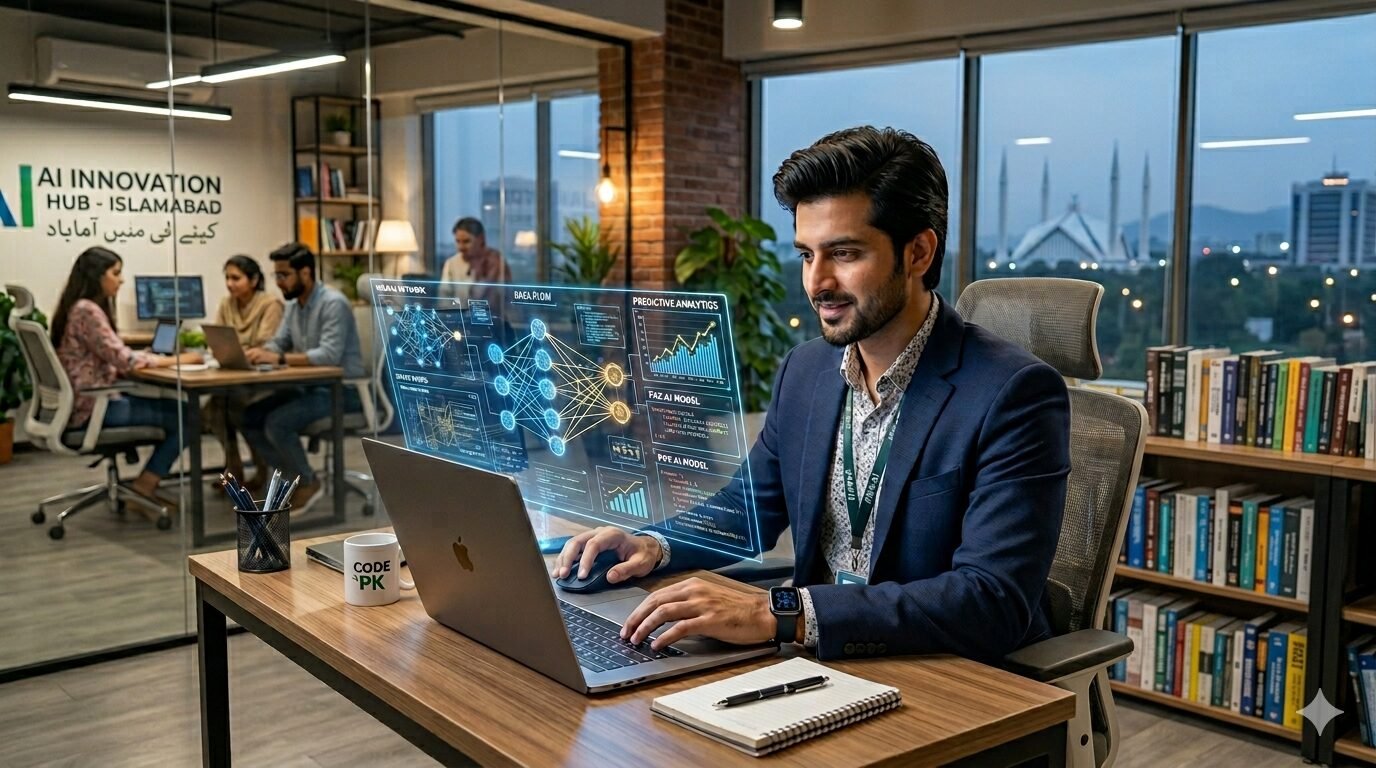
Over the last few years, Pakistan’s Digital Ecosystem has grown rapidly. More people now use smartphones, social media, and internet services than ever before. Because of this, AI tools are becoming easier to access across different cities and industries.
According to DataReportal, Pakistan had 194 million mobile connections in late 2025. This equals nearly 76% of the population. The same report also showed that internet users reached 117 million people, while social media identities crossed 79 million. These numbers matter because Artificial Intelligence depends heavily on digital access. The more connected a country becomes, the faster new technology spreads.
At the same time, the conversation around AI jobs in Pakistan is growing. Students, freelancers, and businesses are all trying to understand how this technology may affect their future. Many people are excited about new opportunities. However, others are worried about job security and changing skill demands. Both concerns are understandable.
Research shared by SHAD Foundation highlights this shift clearly. According to their findings, 86% of higher education students now use AI as a research partner. In addition, around 70% of job skills are expected to change by 2030 because of Artificial Intelligence.
For Pakistan’s young population, this creates both pressure and opportunity.
How AI Is Entering Pakistan’s Daily Life
AI is no longer limited to global tech companies. It is slowly becoming part of ordinary life in Pakistan as well.
Students are using AI tools for research, writing, and learning support. Businesses are using automation to improve customer service and marketing. Freelancers are also using AI to increase productivity and compete globally. This shift is especially visible in online work. Many young Pakistanis now depend on digital platforms for income. Because of this, understanding AI tools is becoming an important skill.

At the same time, AI courses in Pakistan are becoming more common. Universities, private institutes, and online platforms are all expanding their technology programs.
Even small businesses are adapting. Some are using AI-powered chat systems, automated designs, and data tools to improve efficiency. As a result, technology is slowly changing how people approach work and education.
AI and Pakistan’s Growing Skills Gap
Pakistan’s biggest challenge may not be technology itself. Instead, it may be the lack of practical skills needed to keep up with it.
Many educational systems still focus heavily on memorization and theory. However, AI-driven industries now require adaptability, creativity, and technical understanding. This gap is becoming more visible every year.
Some major concerns include:
- Limited practical technology training in many institutions
- Lack of awareness about AI jobs in Pakistan
- Unequal internet access in rural areas
- Fear of automation replacing traditional jobs
- Low digital literacy in some communities
- Rapid changes in global work requirements
- Growing competition in online work markets
- Limited access to advanced AI courses in Pakistan
Despite these challenges, there is also strong potential for growth. Pakistan has one of the youngest populations in the world. According to SHAD Foundation, nearly 64% of the population is under the age of 30. If these young people gain relevant skills, they could become a major part of the global digital workforce.
Why AI Could Create New Opportunities
Although many people focus on job replacement, AI may also create entirely new opportunities. In Pakistan, freelancing and remote work have already expanded significantly over the past decade. Artificial Intelligence may further increase this shift by helping workers improve productivity and access international markets.
For example, digital marketers now use AI tools for research and analytics. Writers use them for content planning. Designers use them for faster workflows. This does not mean human skills are disappearing. Instead, the nature of work is changing. People who combine creativity, communication, and technology skills may adapt more successfully than those relying only on traditional methods.

The rise of AI courses in Pakistan also shows that awareness is growing. More students are now exploring fields like data science, automation, machine learning, and digital strategy.
In many ways, Pakistan is entering a transition period. The country’s Digital Ecosystem is still developing, but its youth population creates strong long-term potential.
The Future of AI in Pakistan
AI will likely affect Pakistan gradually rather than overnight. However, the changes may still happen faster than many people expect. The country already has millions of internet users, a growing freelance economy, and a large young population. These factors create the right environment for technological change.
At the same time, challenges still remain. Access to quality education, stable internet, and practical training continues to vary across different regions. Even so, conversations around Artificial Intelligence are becoming more common in schools, businesses, and workplaces. More people are beginning to see technology not only as a tool, but also as a survival skill.
The future may depend less on whether AI arrives in Pakistan and more on how prepared people are when it does. With better digital education, stronger skill development, and accessible technology training, Pakistan could benefit significantly from this transition.
However, without preparation, the gap between skilled and unskilled workers may continue to grow.


