
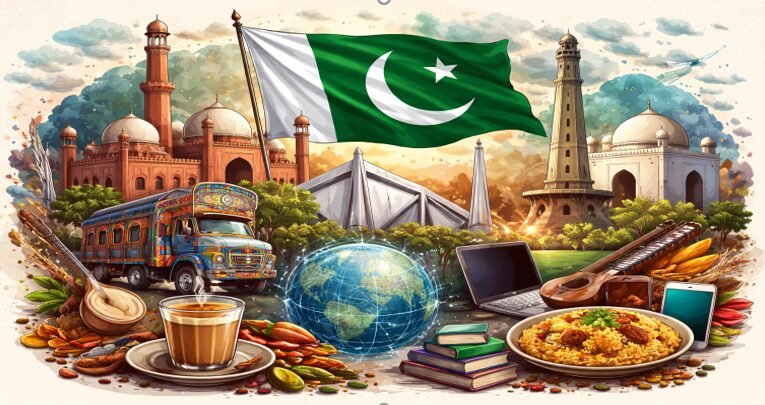
In an increasingly interconnected world, national identities are continuously evolving. Globalization has reshaped cultures, economies, and social values, creating both opportunities and challenges for nations striving to preserve their uniqueness. Pakistani identity, deeply rooted in history, faith, language, and tradition, is no exception. Today, it exists at a crossroads where heritage and global influence intersect, redefining what it means to be Pakistani in the modern era.
Historical and Cultural Foundations of Pakistani Identity
Pakistani identity is grounded in a rich historical legacy that spans ancient civilizations such as the Indus Valley, followed by centuries of Islamic influence, Mughal rule, and British colonialism. This layered past has shaped a society that values resilience, adaptability, and cultural depth.
The creation of Pakistan in 1947 established Islam as a unifying force, providing a shared ideological foundation for a diverse population. Religious values continue to influence social norms, family structures, and ethical principles, forming a central pillar of Pakistani identity.
Language and Diversity as Core Elements
One of the defining features of Pakistan is its linguistic and ethnic diversity. Urdu serves as the national language and a symbol of unity, while regional languages such as Punjabi, Sindhi, Pashto, Balochi, and Saraiki reflect the country’s cultural richness.
In a globalized world, bilingualism and multilingualism have become common, particularly among younger generations who balance English for education and professional growth with native languages for cultural connection. This coexistence highlights Pakistan’s ability to adapt without losing its roots.
Religion and Values in a Global Context
Islam remains a key element of Pakistani identity, shaping moral values, community life, and social responsibility. In the global arena, Pakistani Muslims often navigate the balance between religious traditions and modern lifestyles. This balance is evident in areas such as education, fashion, media, and professional environments, where faith-based values coexist with global norms.
Rather than being static, religious identity in Pakistan is increasingly expressed through personal interpretation, social activism, and community engagement, reflecting a dynamic and evolving relationship with globalization.
The Influence of Global Media and Technology
Global media, social platforms, and digital connectivity have significantly influenced how Pakistanis perceive themselves and the world. Exposure to international ideas, trends, and narratives has reshaped perspectives, particularly among urban youth.
At the same time, Pakistanis are using these platforms to project their own stories globally—through literature, art, fashion, film, and digital entrepreneurship. This cultural exchange allows Pakistani identity to be both locally grounded and globally visible.
Fashion, Food, and Cultural Expression
Traditional clothing such as shalwar kameez remains a strong cultural symbol, even as modern designs and global fashion trends are incorporated. Similarly, Pakistani cuisine—rich in flavor and tradition—continues to be a source of cultural pride, gaining international recognition.
These everyday expressions of culture demonstrate how Pakistani identity evolves by blending tradition with modernity, rather than replacing one with the other.
The Pakistani Diaspora and Global Identity
Millions of Pakistanis living abroad play a crucial role in shaping national identity in a globalized world. The diaspora maintains cultural ties through language, festivals, food, and values, while also integrating into host societies.
This dual identity strengthens Pakistan’s global presence, creating cultural bridges and redefining what it means to be Pakistani beyond geographical boundaries.
Conclusion: A Living, Evolving Identity
Pakistani identity in a globalized world is not defined by a single narrative. It is a living, evolving concept shaped by history, faith, diversity, and global engagement. While globalization introduces change, it also provides an opportunity for Pakistanis to assert their values, share their culture, and redefine their place in the world.
Ultimately, what defines Pakistani identity today is the ability to honor tradition while embracing progress—remaining rooted in cultural heritage while confidently participating in the global community.


