
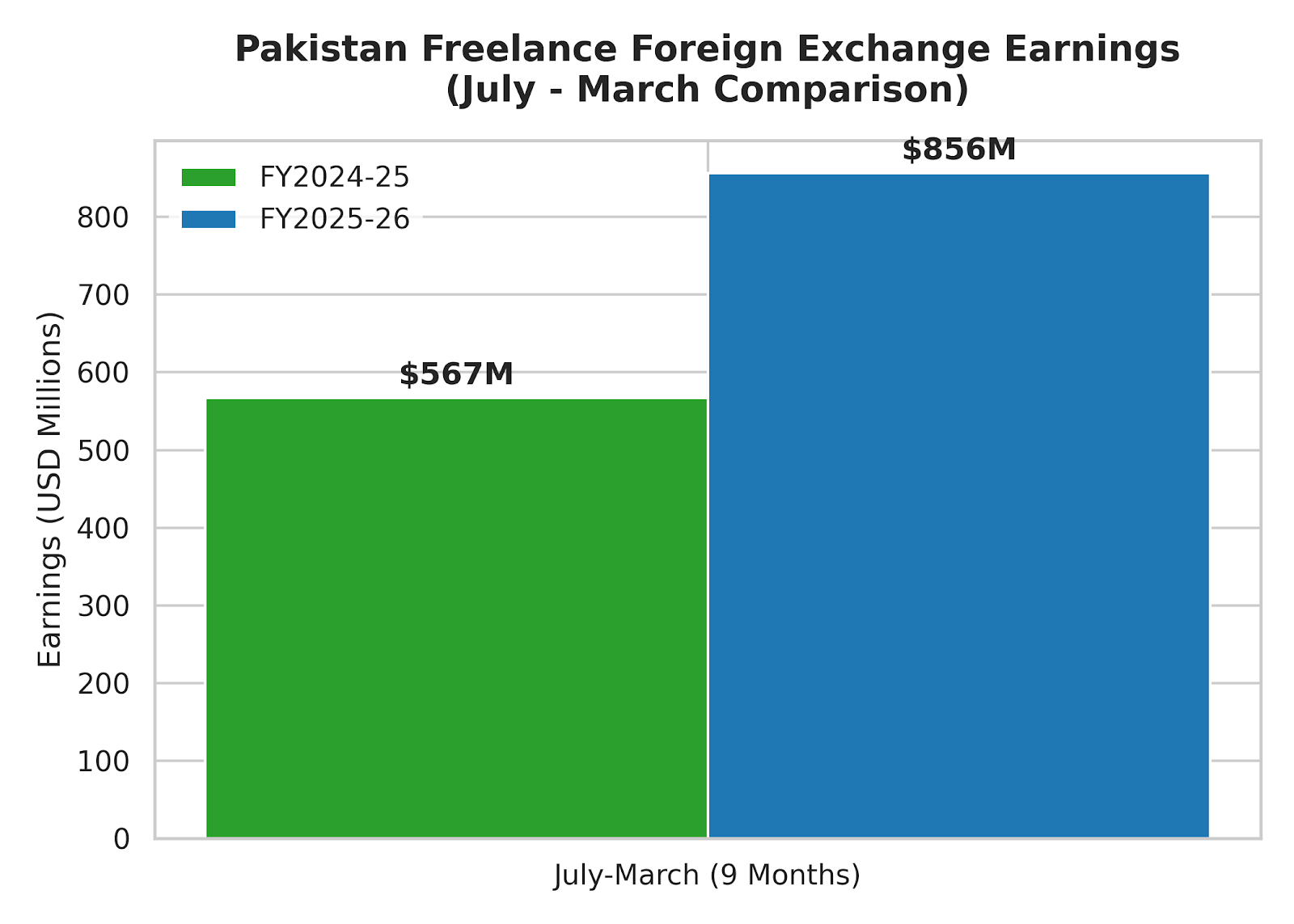
Here’s something that should be making a lot more noise than it is. Pakistan’s freelancers, the developers, designers, writers, marketers, and editors working out of their homes, hostels and cafes, just crossed $1 billion in foreign exchange earnings in the first eleven months of FY2026. That’s not a projection or an estimate. That’s actual money, in actual bank accounts, according to State Bank of Pakistan data reported by Business Recorder.
And the number gets bigger when you factor in non-IT freelancers. Total freelance inflows for the same period hit $1.6 billion. Pakistan’s freelancers are now one of the most reliable sources of foreign currency in the entire economy, and most people still don’t fully grasp how that happened.
This piece gets into all of it. The numbers, the platforms, the people behind the growth, the tax tension that nobody has cleanly resolved, and what needs to happen next.
What Pakistan’s Freelancers Actually Pulled Off This Year
To understand why $1 billion matters, you have to remember where things stood not too long ago. A few years back, freelancing was still something most families didn’t fully understand or trust. It wasn’t a “real job.” Fast forward to today and Pakistan’s freelancers are outpacing entire traditional export sectors.
The Numbers Behind the Milestone
Pakistan’s freelancers generated over $1 billion in foreign exchange during the first eleven months of the current fiscal year, compared to $708 million in the same period last year. That’s a 41% year-on-year increase. Add in the non-IT freelancers and the overall freelancer contribution reaches $1.6 billion for the same period. Business RecorderBusiness Recorder
The earlier part of the year was already showing strong signs. According to data released by the State Bank of Pakistan, export receipts from freelancers in computer and information services increased to $557 million during July to December 2025, compared to $352 million in the same period of the previous fiscal year, a 58% year-on-year jump. The News Pakistan
How 58% Growth in One Year Actually Happened
People often look at growth numbers and assume something unusual happened. In this case, the story is actually pretty straightforward. More people got trained, more people found clients, and the global market kept paying. Awareness of freelancing has grown significantly in recent years, with more individuals acquiring skills through online learning, private institutes, government training programs, and NGO-led initiatives. Momentumpakistan
There’s also a structural reason. The rupee’s depreciation has made Pakistani talent highly cost-competitive for dollar-paying clients, creating an advantage that benefits both sides. Post-COVID remote work normalisation means a client in London or San Francisco no longer thinks twice about hiring someone in Lahore if the work quality is there. That combination of price and quality is hard to beat in a global market. Startup
| Period | Freelance FX Earnings | Year-on-Year Growth |
|---|---|---|
| Jul-Dec 2024 | $352 million | Baseline |
| Jul-Dec 2025 | $557 million | +58% |
| Jul-Apr FY2025 | $642 million | Baseline |
| Jul-Apr FY2026 | $959 million | +49% |
| Jul-May FY2026 | $1 billion+ (IT only) | +41% |
| Total (IT + Non-IT) | $1.6 billion | Notable increase |
Who Are Pakistan’s Freelancers and What Do They Do
The picture most people have of a Pakistani freelancer is a developer on Upwork. That’s part of the story but definitely not all of it.
The Scale of Pakistan’s Freelancing Community
Pakistan’s freelancing community now stands at an estimated 3 million people. According to a report by the Asian Development Bank, Pakistan’s freelancer community is estimated to consist of 2.37 million full-time and part-time individuals, consistently ranked among the top three or four on different global freelancing marketplaces. That ranking puts Pakistan alongside countries with far larger populations and much more developed digital infrastructure. NuktaThe News Pakistan
The work itself spans a wide range. Pakistan’s freelancers are particularly active in software development, digital marketing, graphic design, content creation, and e-commerce. The sector is no longer just coders, it includes people doing video editing, SEO, virtual assistance, translation, and a growing number working in AI-related services. The News Pakistan
The Platforms Pakistan’s Freelancers Rely On
Payoneer is the dominant intermediary for marketplace-based freelancers, with Upwork and Fiverr both paying directly to Payoneer accounts. Wise is the preferred route for direct client payments, offering lower conversion costs and better rates than Payoneer in most cases. Digital Pakistan
PayPal still doesn’t work in Pakistan, which remains a real friction point for many. Most experienced freelancers have worked out a payment stack that minimises the loss at each step, but newer freelancers often figure this out the hard way. The difference between the worst and best payment routing choice can represent three to five percent of each invoice, which at scale is substantial. That’s something worth knowing before you set up your first client contract. Digital Pakistan
This connects to a broader conversation about skills-based careers in Pakistan and why so many young people are now building income outside the traditional job market entirely.
The Tax Question Nobody Has a Clean Answer To
This is where things get a bit uncomfortable, because the same government that’s benefiting from $1.6 billion in freelance inflows is also the one that introduced a new tax on content creators and digital workers under Budget 2026-27.
Pakistan’s Freelancers Already Pay Tax
It’s worth clearing this up, because there’s a lot of confusion around it. Freelancers registered with the Pakistan Software Export Board already operate under a tax system. Freelancers registered with PSEB pay a tax rate of 0.25% on every foreign remittance received in their bank accounts, while a significant majority of unregistered freelancers pay 1% tax on their earnings. Business Recorder
Most freelancers already pay taxes on every transaction and also bear deductions charged by freelancing platforms and payment gateways for transaction services. So the idea that this is an untaxed sector isn’t accurate. What’s true is that enforcement has been inconsistent and many freelancers haven’t formally registered. The Express Tribune
The New Budget and What It Changes
The tension in Budget 2026-27 is real. On one hand, the government extended tax relief for the IT sector. On the other, it introduced a 5% withholding tax on content creator income from platforms like YouTube and TikTok, and there’s been genuine alarm in the freelancing community about where the line is drawn.
Content creators and digital workers have urged the government not to introduce fresh taxes on their income, arguing that the sector brings in foreign exchange, creates jobs, and should be supported through balanced policy measures. PAFLA’s chairman Ibrahim Amin has called for extending the 0.25% tax regime for the next decade, arguing it would encourage freelancers to retain earnings in local banks and motivate students and young professionals to adopt freelancing as a sustainable source of income. Pakistan TodayBusiness Recorder
The concern from industry voices is straightforward. If you tax a sector that’s bringing in foreign exchange and that sector can just operate from another country, the tax revenue you gain might be smaller than the export income you lose. It’s a real policy tension that doesn’t have an easy answer. You can read more about how Pakistan’s broader FBR tax collection trends connect to this picture.
[Image suggestion: A person reviewing their freelance income report on a laptop with Pakistani rupee notes beside them. Alt text: “Pakistan’s freelancers navigating tax rules and foreign exchange regulations”]
What’s Holding Pakistan’s Freelancers Back
The $1 billion milestone is genuinely worth celebrating. But the people actually doing this work will tell you there are real, everyday problems that make it harder than it should be.
Payment Infrastructure Is Still a Problem
Many freelancers continue to incur significant losses due to high transaction fees and deductions imposed by international freelancing platforms and payment service providers. Every time money moves from a foreign client to a Pakistani bank account, something gets taken at each step. For lower-income freelancers, this isn’t a minor inconvenience, it’s a meaningful cut from their actual earnings. The Express Tribune
PAFLA has proposed improving payment infrastructure for freelancers, including the development of a globally interoperable digital payment system tailored to the needs of Pakistan’s digital workforce. That kind of infrastructure would make a real difference, especially for freelancers in smaller cities who don’t always have access to the better banking options available in major urban centres. Business Recorder
Connectivity and Power Cuts Are Real Costs
You can be the most skilled designer on Fiverr and still miss a deadline because the power went out or the internet dropped during a client call. Internet reliability and submarine cable disruptions remain ongoing challenges for the sector, with PAFLA proposing satellite-based internet solutions to reduce connectivity disruptions. Startup
These aren’t abstract policy problems. They’re things that affect people’s incomes and reputations with international clients on a weekly basis. Solving them is arguably as important as any tax policy decision.
All of this sits within the bigger economic picture of Pakistan right now. The country’s foreign exchange reserves have been under pressure for a few years, and the freelancing sector’s contribution is one of the more stable and growing inflows available. That context matters when you think about what policy decisions could either strengthen or undermine this sector. The IMF pressure Pakistan has been navigating also shapes how much flexibility the government has when it comes to offering tax incentives.
What Pakistan’s Freelancers Need Next
The good news is that the direction of growth is clear. The work exists, the talent exists, and more people are entering the sector every year. What’s less clear is whether policy will keep up with that growth or slow it down.
The Case for Long-Term Policy Support
The government’s Uraan Pakistan economic plan has set an IT export target of $10 billion by FY2029, with analysts expecting the sector to grow 18 to 20% this year alone, taking total IT exports to around $4.5 billion. Pakistan’s freelancers are no longer a footnote in that story but one of its most important chapters. Startup
For that target to be realistic, the sector needs stability. Freelancers make long-term decisions about skill investment, platform development, and client relationships. Uncertain tax environments make those decisions harder. Experts have pointed to countries like Bangladesh, where tax holidays and cashback incentives for the IT sector and freelancers have driven rapid growth, as a model Pakistan should consider. The Express Tribune
The billion-dollar milestone is proof that this sector works. The question now is whether the policy environment helps it keep going at the same pace, or introduces enough friction to slow things down.
Final Thoughts
A billion dollars earned by people working independently, without offices or corporate backing, is a real achievement. Pakistan’s freelancers built this from scratch, often without stable internet, without PayPal, and without the kind of formal support most professional sectors take for granted.
The number deserves recognition. But it also deserves a serious policy conversation, one that asks how to protect and grow what’s already working rather than layering new pressure onto a sector that’s genuinely delivering for the economy.
If you’re already freelancing in Pakistan, the data is on your side. If you’re still thinking about it, the skills-based careers landscape has never had more opportunity in it than it does right now. Keep following Landin.pk as we continue covering the stories that actually matter to Pakistan’s digital economy.


