
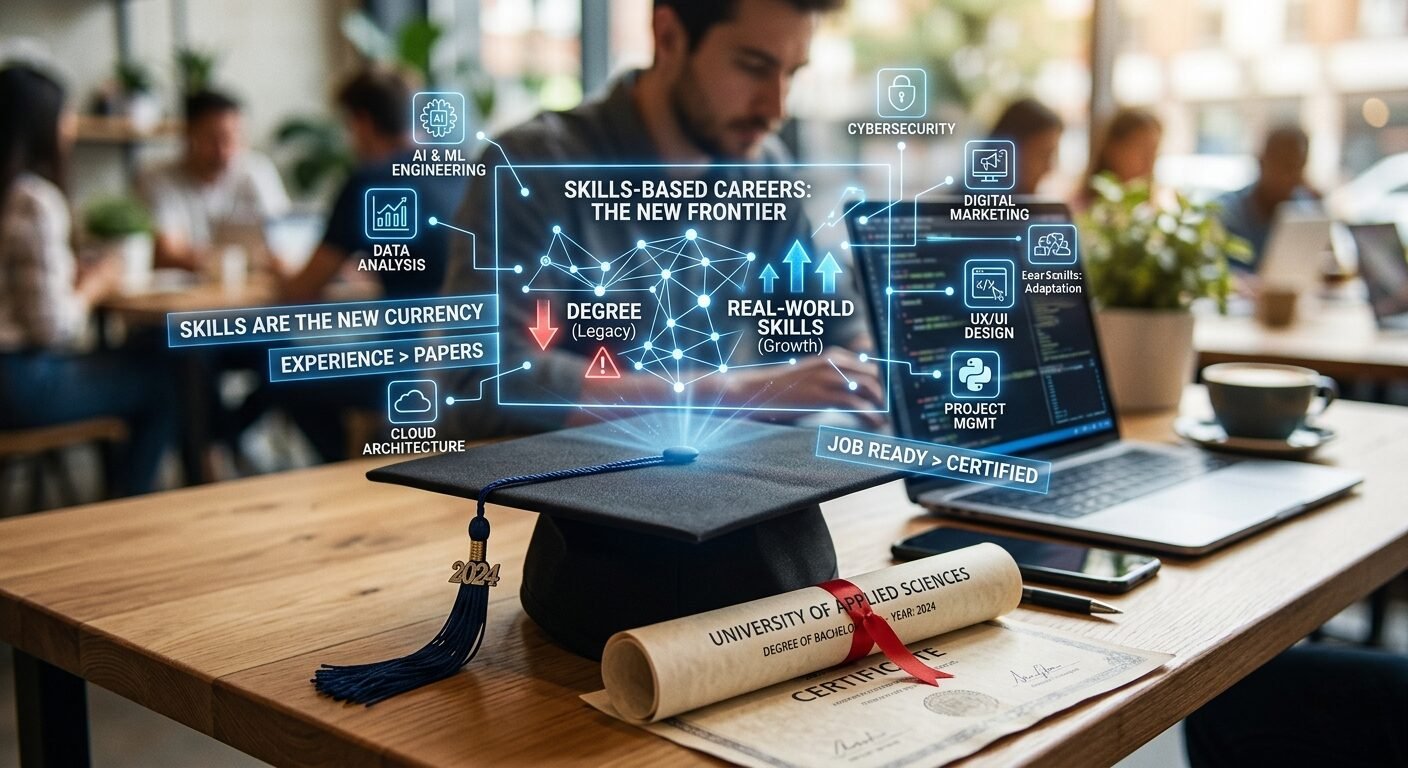
Let’s be honest about something nobody told you in college: that degree you spent four years and a small fortune on isn’t the golden ticket it used to be. And if you’ve been quietly panicking about that, you’re not alone. Across the country, skills based careers in Pakistan are no longer the backup plan — they’re becoming the main plan. Young people are skipping the “find a job after graduation” script and going straight to “build a skill, find clients, get paid.” The numbers back this up in a big way, and so does almost every employer’s hiring behavior right now.
This isn’t a trend piece written from a distance. This is the real shift happening in homes, hostels, and home offices across Karachi, Lahore, Multan, and small towns you’ve probably never heard of. Technology has made online work genuinely accessible to anyone with a laptop and a decent internet connection, regardless of which university crest is printed on their degree. So let’s get into why this is happening, what’s fueling it, and how you can actually be part of it — without falling for the noise.
What Are Skills Based Careers, Really?
A skills based career means you get hired or get clients based on what you can do, not what your transcript says. No four-year wait. No “do you have 3 years of corporate experience” wall blocking your way in.
Employers and clients today want a portfolio, not a transcript. They want to see the website you built, the campaign you ran, or the AI tool you used to automate a workflow. That’s the whole interview now.
From “Where Did You Study” to “What Can You Build” in Skills Based Careers
One freelance training resource summed it up perfectly: employers in Lahore, Karachi, and Islamabad no longer ask where you studied — they ask what you can do. That single sentence captures the entire shift happening in skills based careers in Pakistan right now, and it’s why portfolios are quietly replacing resumes.
Why This Shift Is Happening Right Now
Affordable internet and cheap smartphones opened doors that used to only exist in big cities. A student in a small town can now learn graphic design from a free tutorial and land a client in California by dinner time. On top of that, watching seniors with strong degrees still struggle to find stable jobs made an entire generation start asking a different question: what can I learn that pays me directly, without waiting for someone to hire me? That single question is the real engine behind the rise of skills based careers in Pakistan.

The Government Jumped In With Free Training
Pakistan’s government didn’t just watch this happen — it funded it. NAVTTC’s “Skills of Tomorrow” program, run with the Prime Minister’s Youth Programme, is currently offering free training in high-demand digital skills, including artificial intelligence programs and freelancing-related training, to help young Pakistanis prepare for online career opportunities. This matters even more given how AI could leave Pakistan behind without the right skills if this kind of training doesn’t scale fast enough.
DigiSkills.pk has gone even further, training over 5.5 million people since 2018 to build a skilled workforce and strengthen Pakistan’s digital economy — completely free of cost.
Freelancing also lets people earn in foreign currency, which often pays significantly more than equivalent local salaries — a huge incentive when local inflation keeps climbing.
The Numbers Don’t Lie: Pakistan’s Freelance Economy
If you need hard data before believing a trend is real, here it is. These figures are exactly why skills based careers in Pakistan are being taken seriously by economists, not just young job seekers.
According to State Bank of Pakistan data, Pakistani freelancers earned $557 million in foreign exchange between July and December 2025 alone — a 58% jump from the same period the year before. Zoom out further: Pakistani freelancers earned $856 million in the first nine months of FY2025–26, with a workforce of over 2.37 million registered freelancers, according to an Asian Development Bank estimate.
Where the Money Actually Comes From
| Skill Category | Indicative Monthly Earning (USD) | Best Platform |
| Web Development | $300 – $3,000+ | Upwork, Toptal |
| AI-Augmented Content & SEO/GEO | $200 – $900+ | Upwork, direct clients |
| Digital Marketing | $600 – $3,000 | Upwork, Fiverr |
| Graphic Design & Video Editing | $200 – $1,500 | Fiverr |
| Virtual Assistance (AI-fluent) | $250 – $1,200 | Upwork, Fiverr |
| UI/UX Design | $1,000 – $5,000 | Upwork, Toptal |
Figures are indicative monthly ranges based on current freelance market data and vary by experience, niche, and client type.
This growth isn’t slowing down either — the government is actively making it easier through tax breaks. PSEB-registered freelancers currently pay only 0.25% tax on foreign remittances received through approved banking channels, compared to 1 percent for unregistered freelancers.
Why Online Work Fits Pakistan’s Reality So Well
There’s a practical reason skills based careers in Pakistan are spreading faster here than in many other countries, and it has nothing to do with talent alone.
Online work removes almost every traditional barrier to entry. You don’t need to relocate to a major city, navigate office politics, or wait for a hiring manager to notice your CV in a stack of hundreds. You need a laptop, a stable internet connection, and the discipline to actually learn a skill properly. For a country where commuting costs, housing prices, and office-based job scarcity in big cities are real obstacles, that’s an enormous shift in who gets to participate in the economy — and it ties directly into how Pakistan’s informal economy is evolving alongside this digital shift.
It also fits how younger Pakistanis already use technology. Most people learning these skills today grew up with smartphones, YouTube tutorials, and group chats full of shared resources. Asking them to learn a freelance skill through an app feels far more natural than asking them to sit through a four-year lecture-based degree that may or may not lead to a job afterward. That comfort with technology isn’t a side detail — it’s actually one of the biggest accelerators behind the entire movement.
Here’s where things get genuinely exciting — and a little intimidating if you haven’t started paying attention yet. The biggest misconception about Artificial Intelligence in Pakistan right now is that it’s coming for everyone’s job. The real story is more nuanced. In content writing, for example, the highest-paying work in 2026 isn’t AI-generated articles — it’s AI-assisted content strategy and long-form SEO content, meaning human-led work that guides and edits AI output to meet editorial standards.
Even virtual assistance has been reshaped this way. Assistants fluent in AI tools like ChatGPT, Notion AI, and Zapier are now earning significantly more than generalists who aren’t. That’s the pattern across almost every digital skill today: AI fluency is the multiplier, not the replacement.
SEO Has a New Frontier: GEO
If you’re in content or marketing, this matters. Generative Engine Optimisation — structuring content to appear in AI-generated answers from tools like Google AI Overviews, ChatGPT, and Perplexity — is becoming a high-value emerging specialization in 2026. This is genuinely the next big skill gap in Pakistan’s digital ecosystem, and almost nobody is talking about it yet.
Best AI Courses in Pakistan You Can Start Today
You don’t need a computer science degree to start learning AI. Here’s where to actually go.
NAVTTC’s Skills of Tomorrow program currently runs AI-focused tracks including AI for Everyone, AI Financial Analyst with Power BI, and AI-Augmented Digital Marketing & SEO — government-recognized courses built around the latest AI tools. DigiSkills.pk offers parallel AI paths in data analysis, machine learning, and AI automation, all delivered free through their learning portal.
Other Solid AI Courses in Pakistan Worth Exploring
- PIAIC (Presidential Initiative for AI) — programs for intermediate learners, free or very low-cost, backed by government support.
- Saylani Mass IT Training — free courses in AI and data science for beginners, focused on practical exposure.
- Coursera’s “AI for Everyone” by Andrew Ng — a non-technical introduction ideal for complete beginners, no coding required.
If you’re a total beginner, start non-technical. If you already write, design, or market, layer AI tools onto what you already know instead of starting from zero.
Where to Find AI Jobs in Pakistan
Learning the skill is step one. Getting paid for it is step two, and this is where most people get stuck.
Platforms built specifically for skills based hiring are emerging locally, matching candidates by skills and portfolio rather than degrees alone. But for most beginners, Upwork and Fiverr remain the most realistic entry points into AI jobs in Pakistan — AI-fluent virtual assistants, content strategists, and designers are all in active demand there right now. Don’t ignore local agencies either; many Pakistani companies are actively hiring people who can use AI tools to move faster, not just people who can talk about AI in theory, which is also reshaping how digital marketing in Pakistan is scaling for businesses of every size.

Skills Based Careers vs Traditional Degree Jobs
Let’s settle this comparison once and for all, side by side.
| Factor | Skills Based Career | Traditional Degree Job |
| Time to start earning | Weeks to a few months | 4+ years of study first |
| Upfront cost | Often free (govt programs) | Tuition, hostel, books |
| Income ceiling | Can scale fast with niche skills | Often capped by pay scale |
| Geographic flexibility | Work from anywhere | Often location-bound |
| Entry barrier | Portfolio and proof of work | Degree and credentials |
Neither path is “wrong.” But if you’ve been waiting for permission to start without a degree backing you up, this table is your permission.
Building Your Place in Pakistan’s Digital Ecosystem
A career isn’t just a skill — it’s how you fit into the bigger digital ecosystem around you.
Payments and Registration: Solve This Early
PayPal still doesn’t operate in Pakistan due to State Bank foreign exchange controls, so don’t wait around for it. Payoneer and Wise are the standard, reliable alternatives Pakistani freelancers use to receive international payments. Pair that with early PSEB registration — it’s free, needs only a CNIC, and instantly cuts your tax rate on foreign income.
While Karachi, Lahore, Islamabad, and Faisalabad remain Pakistan’s dominant freelancing hubs, smaller cities like Multan, Sialkot, and Peshawar are building real freelancing communities too. Your city matters less than your internet connection and skill level now.
Common Mistakes People Make
Real talk: not everyone who tries this succeeds, and most failures in skills based careers in Pakistan come down to a handful of avoidable habits.
Jumping between graphic design, copywriting, and coding in the same month means mastering none of them — pick one skill and go deep before diversifying. Many also skip the portfolio step entirely, trying to apply for AI jobs in Pakistan with zero proof of work, which almost never lands a client. Others treat this like a lottery ticket, expecting one viral gig to change everything, when consistency is what actually pays. And plenty of people wait too long to register with PSEB or set up Payoneer properly, which ends up costing them money they didn’t need to lose.
Your First 90 Days: A Real Action Plan
No fluff here — just what actually moves you forward, broken into three realistic phases.
Days 1-30: Pick and Learn. Choose one skill instead of five. Enroll in a free course through NAVTTC, DigiSkills, or PIAIC depending on what fits your interest and schedule. Commit to daily practice in your chosen technology stack or tool, even if it’s just one focused hour. This is the foundation phase — resist the urge to rush into client work before you’ve actually built the skill.
Days 31-60: Build Proof. Create 3-5 portfolio pieces that show real, applied work, not just course exercises. Set up your Payoneer account so you’re ready to receive international payments. Register with PSEB while it’s still simple. Build a clean, focused profile on Fiverr or Upwork that speaks directly to one niche instead of trying to appeal to everyone.
Days 61-90: Get Your First Client. Send pitches daily, not occasionally. Price slightly lower than market rate for your first 2-3 clients to build reviews and trust, then raise your rates once you have proof that people will actually pay for your work. This is also the point where most beginners quit — push past it, because client number two is always easier than client number one.
CONCLUSION
If there’s one thing to take from all of this: skills based careers in Pakistan aren’t a backup plan anymore. They’re a legitimate, government-backed, dollar-earning path that’s wide open right now. The training is free, the platforms exist, and the only missing piece is you actually starting.
Don’t let this become another blog you read and forget by tomorrow. Pick one skill from this list, enroll in a free course this week, and tell us in the comments which one you’re starting with — we’ll be cheering you on every step of the way.
For more deep dives into Pakistan’s evolving digital economy, explore our related reads on how Pakistan’s informal economy is evolving, why AI could leave Pakistan behind without the right skills, and digital marketing’s growth and business impact in Pakistan on Landin.pk.


