
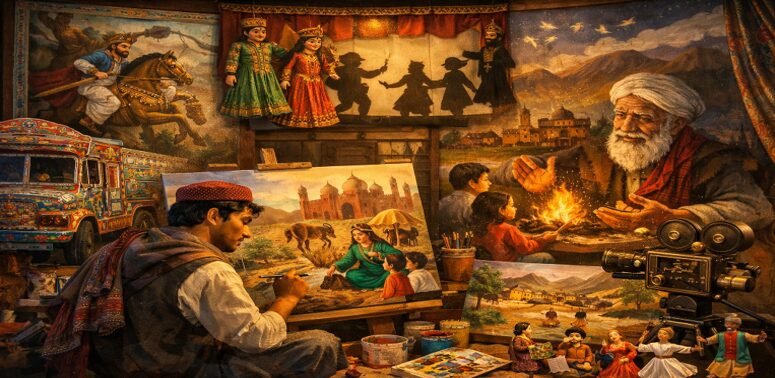
Storytelling has always been at the heart of Pakistani culture. From ancient cave paintings to contemporary digital illustrations, visual arts in Pakistan have long served as a powerful medium for narrating history, identity, struggle, and hope. Rooted in centuries-old traditions and continuously reshaped by modern influences, Pakistani visual art tells stories that words alone often cannot capture.
The Cultural Roots of Visual Storytelling in Pakistan
Pakistan’s visual storytelling tradition draws heavily from its rich and diverse heritage. Mughal miniature painting is one of the earliest and most refined examples, where artists narrated royal histories, courtly life, and epic tales through intricate details and symbolism. These artworks were not merely decorative; they were visual narratives that documented social structures, political power, and cultural values.
Folk art also plays a vital role in visual storytelling. Truck art, truck poetry, Sindhi ajrak patterns, Kashmiri wood carvings, and Balochi embroidery all convey stories of regional identity, beliefs, and everyday life. Each color, motif, and pattern carries meaning, reflecting the emotions and experiences of local communities.
Visual Arts as a Reflection of Society
Modern Pakistani visual artists often use their work to comment on social realities. Paintings, murals, photography, and mixed-media installations explore themes such as identity, gender, migration, urbanization, and political change. Through visual metaphors and symbolic imagery, artists highlight issues that shape contemporary Pakistan.
Street art, in particular, has emerged as a strong storytelling tool. Murals in cities like Karachi, Lahore, and Islamabad narrate stories of resilience, cultural pride, and social awareness. These public artworks transform ordinary spaces into visual conversations, making art accessible to a wider audience.
Contemporary Artists and New Narratives
Contemporary Pakistani artists are redefining storytelling through innovative approaches. They blend traditional techniques with modern styles, digital media, and conceptual art. Photography and visual documentaries capture untold stories of marginalized communities, rural life, and changing urban landscapes.
Digital art and illustration have further expanded the reach of visual storytelling. Social media platforms allow artists to share narratives instantly, connecting local stories with global audiences. This digital shift has enabled Pakistani visual art to gain international recognition while preserving its cultural essence.
The Role of Visual Arts in Preserving Identity
In a rapidly globalizing world, visual arts in Pakistan play a crucial role in preserving cultural identity. Artists often revisit historical symbols, calligraphy, and indigenous crafts to reconnect with their roots. These visual narratives help younger generations understand their heritage while encouraging dialogue between tradition and modernity.
Art exhibitions, galleries, and cultural festivals across Pakistan provide platforms for these stories to be seen and appreciated. They foster cultural exchange and promote a deeper understanding of Pakistan’s artistic voice.
Storytelling Through Visual Arts: A Living Tradition
Storytelling through visual arts in Pakistan is not confined to the past; it is a living, evolving tradition. Whether through a centuries-old miniature painting or a contemporary digital illustration, Pakistani artists continue to tell stories that reflect the nation’s soul. Their work captures memories, challenges perspectives, and celebrates the resilience and creativity of the people.
As visual arts continue to evolve, they remain one of the most powerful ways to understand Pakistan’s history, culture, and future—one story, one image, and one canvas at a time.


